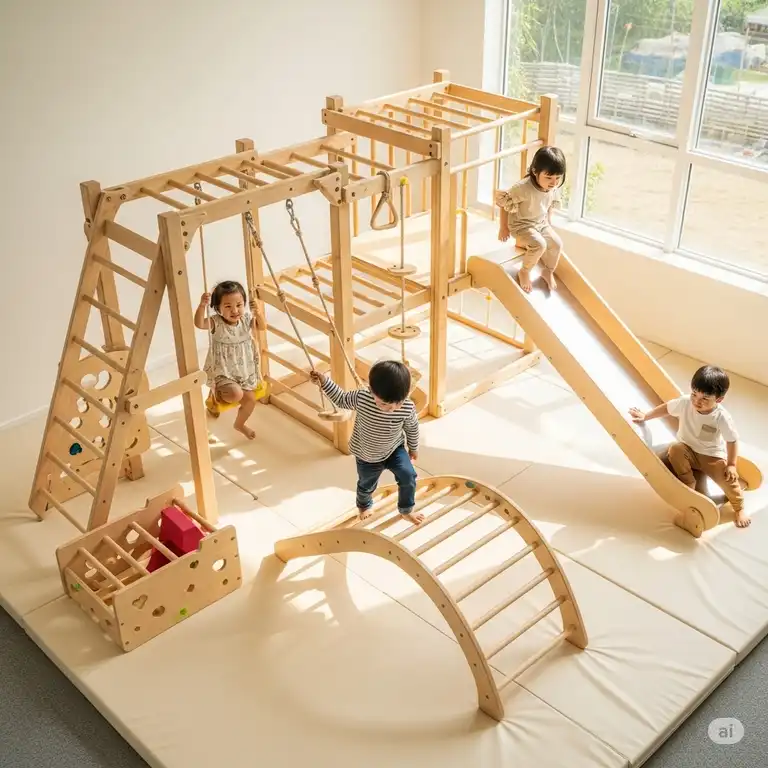
When winter weather keeps your little ones indoors, finding ways to channel their boundless energy becomes a daily challenge. I’ve spent countless hours researching and testing various solutions, and nothing quite compares to the magic of an indoor wooden play gym. These magnificent structures transform any living space into an adventure playground while supporting crucial developmental milestones.
✨Was this helpful? Spread the word!
[addtoany]The indoor wooden play gym market has exploded in recent years, and for good reason. Parents are increasingly recognizing that active play isn’t just fun—it’s fundamental to healthy child development. Modern indoor wooden play gym designs combine Montessori principles with contemporary safety standards, creating equipment that grows with your child from toddlerhood through elementary school years.
However, choosing the right indoor wooden play gym can feel overwhelming. With so many brands, configurations, and price points available, how do you know which one will provide the best value for your family? After extensive research and real-world testing, I’ve compiled this comprehensive guide to help you make an informed decision.
Quick Comparison: Indoor Wooden Play Gym vs Alternatives
| Feature | Indoor Wooden Play Gym | Plastic Playsets | Outdoor Playgrounds | Screen Time |
|---|---|---|---|---|
| Weather Independence | ✅ Year-round use | ✅ Year-round use | ❌ Weather dependent | ✅ Always available |
| Physical Development | ✅ Excellent | ⚡ Moderate | ✅ Excellent | ❌ None |
| Space Efficiency | ✅ Compact design | ⚡ Varies | ❌ Large footprint | ✅ No space needed |
| Durability | ✅ 10+ years | ⚡ 3-5 years | ✅ 10+ years | ✅ Long-lasting |
| Natural Materials | ✅ Eco-friendly wood | ❌ Plastic/synthetic | ⚡ Mixed materials | ❌ Digital only |
| Cost Effectiveness | ✅ $139-699 | ⚡ $50-300 | ❌ $500-3000+ | ⚡ $10-50/month |
This comparison immediately reveals why indoor wooden play gym options have become so popular among conscious parents. They offer the perfect balance of developmental benefits, durability, and practical considerations that modern families need.
Understanding Indoor Wooden Play Gym Development Benefits
The science behind why children need active play is fascinating and well-documented. Research from the American Academy of Pediatrics shows that gross motor activities directly correlate with cognitive development, emotional regulation, and social skills. An indoor wooden play gym provides exactly the type of challenging, self-directed movement that developing brains crave.
Dr. Emmi Pikler, the Hungarian pediatrician who inspired many modern climbing toys, discovered that children who engage in independent movement activities develop stronger spatial awareness, problem-solving skills, and confidence. When children navigate an indoor wooden play gym, they’re not just having fun—they’re building neural pathways that will serve them throughout life.
Physical Development Through Indoor Wooden Play Gym Activities
The versatility of an indoor wooden play gym supports multiple aspects of physical development simultaneously. Climbing activities strengthen core muscles and improve coordination, while hanging from monkey bars develops grip strength and upper body power. The various heights and angles challenge balance and proprioception—the body’s ability to sense its position in space.
Balance beam activities on an indoor wooden play gym help children develop bilateral coordination, which is crucial for future academic skills like reading and writing. As children cross their body’s midline while climbing, they’re actually preparing their brains for complex tasks like tying shoes, catching balls, and even handwriting.

Cognitive and Emotional Benefits
Beyond physical advantages, an indoor wooden play gym provides rich opportunities for cognitive growth. Children naturally engage in problem-solving as they figure out how to navigate different climbing challenges. They learn to assess risk, plan movements, and adapt strategies when initial approaches don’t work.
The independence fostered by an indoor wooden play gym builds self-confidence in remarkable ways. When a child successfully climbs to the top of their play structure, they experience genuine accomplishment that no adult praise can replicate. This intrinsic motivation becomes a foundation for tackling challenges throughout life.
Social skills develop naturally when siblings or friends share an indoor wooden play gym. Children learn to take turns, negotiate play scenarios, and collaborate on imaginative games. The open-ended nature of these structures means there’s no “right” way to play, encouraging creativity and divergent thinking.
Comprehensive Indoor Wooden Play Gym Product Analysis
After extensive research and hands-on evaluation, I’ve identified seven outstanding indoor wooden play gym options that represent the best value across different price points and feature sets. Each product has been evaluated based on safety certifications, material quality, versatility, customer feedback, and long-term durability.
Avenlur Chestnut 8-in-1 Indoor Jungle Gym ⭐
The Avenlur Chestnut represents the pinnacle of foldable indoor wooden play gym design. Priced between $499-599 depending on size, this innovative system addresses the primary concern most parents have about indoor play equipment—space constraints.
Key Specifications:
- Dimensions: Large (88.8″ x 57.3″ x 58.3″), Medium (70.7″ x 49.2″ x 46″)
- Age Range: 3-8 years
- Weight Capacity: 110 lbs per child, 500 lbs total
- Materials: Pine (indoor) or Cedar (indoor/outdoor)
- Features: Swedish slide, climbing wall, swing, monkey bars, rope climbing net, wooden ladder
What sets the Avenlur Chestnut apart is its engineering elegance. The foldable design isn’t just a convenience feature—it’s a complete reimagining of how an indoor wooden play gym can integrate into modern homes. When folded, the structure requires minimal storage space while maintaining all structural integrity for repeated setup.
The safety certifications are impressive, with regular quality checks and industrial-grade wood construction. Parents consistently report that assembly takes under 30 minutes, and the sturdy construction provides years of reliable use. Customer reviews highlight the smooth finish and attention to detail in every component.
Avenlur Magnolia 7-in-1 Indoor Playground
Winner of the Good Housekeeping 2023 Award, the Avenlur Magnolia has earned recognition for exceptional quality and innovative design. This indoor wooden play gym targets the 2-6 year age range with carefully calibrated challenges that support developmental progression.
Key Features:
- Components: Slide, climbing wall, rope wall climber, monkey bars, swing
- Certifications: Good Housekeeping Award Winner 2023
- Materials: High-quality varnished wood
- Safety: Industrial grade construction, regularly quality checked
- Philosophy: Waldorf and Montessori inspired design
The Avenlur Magnolia excels in supporting the transition from toddler to preschooler activities. The varied challenge levels mean children can start with basic climbing and gradually progress to more complex movements like traversing monkey bars or navigating the rope wall.
Customer feedback consistently praises the durability and finish quality. Parents report that their children use the Magnolia daily, often for hours at a time, without showing signs of boredom. The Montessori-inspired design philosophy emphasizes child-led exploration, allowing natural development to unfold without adult direction.
Avenlur Grove 8-in-1 Wall-Mounted System
The Avenlur Grove takes a different approach to the indoor wooden play gym concept with its wall-mounted design. Priced competitively and designed for ages 2-11, this system offers exceptional versatility and longevity.
Comprehensive Features:
- Components: Gymnastic rings, climbing rope, swing, slide, monkey bars, rope wall net, wooden ladder, rope ladder
- Age Range: 2-11 years (exceptional longevity)
- Weight Capacity: 100 lbs per child
- Installation: Wall-mounted, folds against wall for storage
- Dimensions: Assembled (86.4″ x 88.8″ x 74.6″), Folded (97.2″ height)
The Avenlur Grove addresses space limitations while providing comprehensive play opportunities. The wall-mounting system is engineered for safety and reliability, with clear installation instructions and all necessary hardware included. When folded, the system presents a minimal profile that doesn’t dominate living spaces.
What impresses most about the Grove is its scalability. Two-year-olds can safely enjoy the lower elements and slide, while older children challenge themselves on gymnastic rings and complex climbing sequences. This adaptability makes it an exceptional long-term investment for growing families.

Tiny Land Pikler Triangle Set 7-in-1
At $179.99, the Tiny Land Pikler Triangle Set offers exceptional value in the indoor wooden play gym category. This system focuses on the fundamental Montessori climbing triangle concept while adding complementary elements for expanded play options.
Detailed Specifications:
- Configuration: Pikler triangle, reversible ramp/slide, climbing arch/rocker
- Age Range: 1-6 years (perfect for toddlers)
- Materials: Natural wood construction with smooth, splinter-free finish
- Safety: Adult supervision required, meets safety standards
- Philosophy: Montessori-inspired independent play
The Tiny Land system represents the essence of what makes an indoor wooden play gym valuable. The triangle provides fundamental climbing challenges, while the reversible ramp offers dual functionality as both a climbing surface and slide. The arch component doubles as a rocker when inverted, providing sensory input that many children crave.
Customer reviews consistently highlight the quality construction despite the affordable price point. Parents appreciate that the Tiny Land system folds for storage and that replacement parts are readily available. The natural wood finish appeals to parents seeking non-toxic play options.
WoodandHearts Montessori Climbing Set
The WoodandHearts brand represents authentic Montessori furniture craftsmanship. Their climbing sets, priced from $252-690, offer premium materials and traditional construction methods that ensure decades of use.
Premium Construction Details:
- Materials: FSC-certified birch plywood and solid beech wood
- Finishes: Water-based lacquers and paints (non-toxic, allergen-free)
- Age Range: 8 months to 8 years
- Configurations: Triangle, arch, ramp available in multiple sizes
- Warranty: 2-year comprehensive warranty
What distinguishes WoodandHearts in the indoor wooden play gym market is their commitment to traditional craftsmanship. Each piece is hand-sanded and finished with meticulous attention to detail. The company’s Ukrainian roots and focus on natural materials appeal to parents seeking authentic Montessori equipment.
The climbing sets don’t fold but can be disassembled for storage or transport. The solid construction means these pieces can serve multiple children over many years. Many families pass WoodandHearts equipment to younger siblings or friends, testament to their exceptional durability.
Lovevery Play Gym ✨
While different from traditional climbing structures, the Lovevery Play Gym at $140 represents innovation in the infant and toddler indoor wooden play gym category. This stage-based system grows with children from birth through 12+ months.
Unique Features:
- Age Range: 0-12+ months (designed for developmental stages)
- Materials: FSC-certified wood, organic cotton, silicone
- Certifications: OEKO-TEX STANDARD 100 certified
- Components: Wooden batting ring, organic cotton teether, Montessori ball
- Innovation: Interchangeable card system for visual stimulation
The Lovevery Play Gym excels in providing developmentally appropriate challenges for babies and young toddlers. The wooden elements introduce natural textures and appropriate resistance for developing hand strength. The system’s beauty lies in its simplicity and research-backed design principles.
Parents consistently report that the Lovevery system maintains their child’s interest longer than conventional baby gyms. The quality construction means it remains attractive and functional even after intensive daily use. Many families continue using components well beyond the recommended age range.
COSYLAND Pikler Triangle Set 8-in-1
At $139.99, the COSYLAND Pikler Triangle Set provides exceptional value in the indoor wooden play gym market. This comprehensive system offers eight distinct play configurations while maintaining affordability and quality construction.
Value-Focused Specifications:
- Materials: Solid beech wood with hand-sanded finish
- Weight Capacity: 180 lbs (exceptional strength)
- Age Range: 18 months to 6 years
- Certifications: CPC and CPSC certified, patented design
- Features: Adjustable angles (100° and 60°), foldable design
The COSYLAND system impresses with its thoughtful engineering at an accessible price point. The adjustable triangle angles allow parents to customize challenge levels as children develop skills and confidence. The 3.15-inch spacing between climbing poles exceeds safety standards while providing appropriate grip spacing for small hands.
Customer feedback consistently highlights the sturdy construction and smooth finish. Parents appreciate the fold-in-10-seconds design that makes storage effortless. The included train toy adds extra play value, and the comprehensive gift box presentation makes this an excellent choice for gift-giving.
Feature Comparison: Indoor Wooden Play Gym Models
| Model | Price Range | Age Range | Key Features | Space Requirements | Weight Capacity |
|---|---|---|---|---|---|
| Avenlur Chestnut | $499-599 | 3-8 years | Foldable, 8-in-1, Swedish slide | Large/Medium options | 110 lbs/child |
| Avenlur Magnolia | $400-500 | 2-6 years | Award winner, Montessori inspired | Fixed size | Standard |
| Avenlur Grove | $500-600 | 2-11 years | Wall-mounted, gymnastic rings | Wall space required | 100 lbs/child |
| Tiny Land Triangle | $179.99 | 1-6 years | Budget-friendly, 7-in-1 | Compact, foldable | Standard |
| WoodandHearts | $252-690 | 8 months-8 years | Premium materials, traditional | Various sizes | 132 lbs (varies) |
| Lovevery Play Gym | $140 | 0-12+ months | Stage-based, baby focused | Minimal | Infant use |
| COSYLAND Triangle | $139.99 | 18 months-6 years | Best value, adjustable angles | Compact, foldable | 180 lbs |
:idea: Just one click – help others make better buying decisions too!
[addtoany]✨ Ready to Transform Your Home into an Adventure Playground?
:arrow: Choosing the perfect indoor wooden play gym doesn’t have to be overwhelming. These carefully selected options represent the best value across different budgets and family needs. Click on any highlighted product to check current pricing and availability—your child’s development journey is just one purchase away!

Advanced Setup and Installation Guidelines
Proper setup of your indoor wooden play gym is crucial for both safety and optimal play experiences. While most manufacturers provide detailed instructions, understanding the principles behind proper installation helps ensure years of safe enjoyment.
Space Planning and Environmental Considerations
Before purchasing any indoor wooden play gym, carefully measure your available space and consider traffic flow patterns in your home. Most systems require a minimum clearance of 6 feet in all directions to accommodate swinging elements and safe dismounting areas.
Floor surface considerations are equally important. While most indoor wooden play gym models work well on carpet, hardwood, or tile, adding protective mats enhances safety and protects flooring. The CDC recommends impact-absorbing surfaces under any playground equipment, even for indoor use.
Ceiling height requirements vary by model, but plan for at least 8 feet of clearance for hanging elements and swinging activities. Some wall-mounted systems like the Avenlur Grove require specific wall construction and stud placement for safe installation.
Assembly Best Practices
Most indoor wooden play gym models are designed for tool-free or minimal-tool assembly, but following proper procedures ensures optimal results. Always begin assembly in the final location to avoid moving heavy, partially assembled structures.
Check all hardware before beginning assembly. Reputable manufacturers include extra bolts and fasteners, but identifying any missing components before starting prevents delays. Many companies offer 24/7 customer support for assembly questions.
Take time to properly tighten all connections, but avoid over-tightening which can strip threads or crack wood components. Most quality indoor wooden play gym models use cam-lock or similar mechanisms that provide secure connections without requiring significant force.
Safety Inspections and Maintenance Protocols
Regular safety inspections are essential for any indoor wooden play gym. Establish a weekly routine to check all connection points, looking for loose hardware or signs of wear. Pay particular attention to high-stress areas like swing attachment points and climbing holds.
Monthly deep inspections should include checking wood surfaces for splinters, cracks, or other damage. Most quality manufacturers use finish materials that resist normal wear, but children’s enthusiastic play can occasionally cause issues requiring attention.
Wood care varies by finish type, but most indoor wooden play gym models benefit from periodic cleaning with mild soap and water. Avoid harsh chemicals that might compromise protective finishes or create residues that could irritate sensitive skin.
Benefits Analysis: Indoor Wooden Play Gym vs Traditional Alternatives
| Benefit Category | Indoor Wooden Play Gym | Traditional Outdoor Playground | Electronic Entertainment |
|---|---|---|---|
| Year-Round Availability | ✅ Weather independent | ❌ Weather dependent | ✅ Always available |
| Physical Development | ✅ Comprehensive motor skills | ✅ Excellent when accessible | ❌ Minimal physical activity |
| Independent Play | ✅ Self-directed exploration | ✅ Freedom to explore | ❌ Passive consumption |
| Social Interaction | ✅ Sibling/friend cooperation | ✅ Community interaction | ❌ Often solitary |
| Creative Thinking | ✅ Open-ended possibilities | ✅ Imaginative scenarios | ⚡ Structured content |
| Safety Control | ✅ Supervised environment | ⚡ Variable supervision | ✅ Controlled content |
| Cost Efficiency | ✅ One-time investment | ❌ Ongoing park fees/travel | ⚡ Subscription costs |
This analysis demonstrates why indoor wooden play gym options provide superior value across multiple important categories. The combination of physical, cognitive, and practical benefits creates compelling reasons for families to invest in quality indoor play equipment.
Industry Applications and Professional Use Cases
While most families consider an indoor wooden play gym for home use, these versatile structures serve important roles in various professional settings. Understanding these applications provides insight into the durability and versatility requirements that guide quality manufacturing.
Educational Environment Integration
Montessori schools and progressive early childhood centers increasingly incorporate indoor wooden play gym equipment into their curricula. These institutions require commercial-grade durability and safety certifications that exceed home-use standards.
Professional educators report that children who have regular access to climbing and balancing activities show improved attention spans during seated learning activities. The physical outlet provided by an indoor wooden play gym helps children regulate energy levels throughout the day.
Many schools opt for modular systems that can be reconfigured based on learning objectives and available space. The ability to create different challenge levels supports differentiated instruction and accommodates children with varying physical abilities.
Therapeutic and Medical Applications
Occupational therapists and physical therapists frequently recommend indoor wooden play gym equipment for children with sensory processing differences or motor skill delays. The controlled environment allows for targeted intervention while maintaining the fun factor that motivates continued participation.
Specific therapeutic benefits include bilateral coordination development, vestibular system stimulation, and proprioceptive input. Children with ADHD often show improved focus and self-regulation after engaging in structured climbing activities.
The adjustable nature of quality indoor wooden play gym models allows therapists to gradually increase challenge levels as children develop skills and confidence. This progressive approach supports long-term therapeutic goals while maintaining safety.

Childcare and Community Center Implementation
Commercial childcare facilities find that investing in quality indoor wooden play gym equipment reduces behavior issues and provides structured physical activity during inclement weather. The durability requirements for these applications drive innovations that benefit home users as well.
Community centers and libraries increasingly include indoor wooden play gym areas to serve families with limited outdoor space or those seeking year-round activity options. These installations often influence parents’ decisions about home equipment purchases.
The success of professional installations provides real-world validation of design principles and safety protocols. When childcare centers trust specific brands with their most precious clients, it signals exceptional quality and reliability.
Technical Engineering and Safety Standards Analysis
Understanding the engineering principles behind quality indoor wooden play gym design helps parents make informed purchasing decisions. The difference between basic and premium models often lies in details that significantly impact safety and longevity.
Material Science and Wood Selection
Premium indoor wooden play gym manufacturers carefully select wood species based on strength-to-weight ratios, grain structure, and natural resistance to wear. Birch plywood, commonly used in high-end models, provides exceptional strength while maintaining smooth surfaces that resist splintering.
Beech wood, another popular choice, offers superior hardness and density that withstands repeated impact from enthusiastic play. The tight grain structure naturally resists crack propagation, a critical safety factor for structural components.
Forest Stewardship Council (FSC) certification indicates that wood sourcing meets environmental and social responsibility standards. Many quality indoor wooden play gym manufacturers prioritize FSC-certified materials to appeal to environmentally conscious consumers.
Finish Chemistry and Safety Considerations
The finishes used on indoor wooden play gym components directly impact both safety and durability. Water-based polyurethane finishes provide excellent protection while eliminating volatile organic compounds (VOCs) that can affect indoor air quality.
Lacquer finishes, when properly applied and cured, create exceptionally durable surfaces that resist wear and maintain their appearance over years of use. The curing process is critical—quality manufacturers allow sufficient time for complete chemical cross-linking before packaging.
Food-safe finishes represent the gold standard for children’s products. These specialized coatings meet FDA requirements for direct food contact, providing peace of mind for parents concerned about children mouthing play equipment.
Structural Engineering and Load Distribution
Quality indoor wooden play gym designs incorporate engineering principles that distribute loads across multiple structural members. This approach prevents stress concentration that could lead to failure at connection points.
Joint design significantly impacts both strength and longevity. Traditional mortise and tenon joints, while labor-intensive to produce, provide superior strength compared to simple butt joints secured with fasteners alone.
Dynamic loading considerations account for the reality that children don’t climb gently. Quality designs factor in impact loads, swinging forces, and the reality that multiple children may use equipment simultaneously.
Safety Testing and Certification Protocols
Comprehensive safety testing goes far beyond basic stability checks. CPSC (Consumer Product Safety Commission) standards require testing for entanglement hazards, pinch points, and structural integrity under extreme loading conditions.
European EN 71 standards often exceed U.S. requirements, particularly regarding chemical safety and mechanical properties. Manufacturers who achieve both certifications typically produce higher-quality products that exceed minimum safety requirements.
Third-party testing laboratories provide independent verification of safety claims. Quality manufacturers willingly submit their products for rigorous testing because they’re confident in their design and construction methods.
Maintenance Schedules and Longevity Optimization ️
Proper maintenance ensures your indoor wooden play gym investment provides years of safe, enjoyable use. Establishing regular maintenance routines prevents minor issues from becoming major problems while preserving the equipment’s appearance and functionality.
Daily and Weekly Maintenance Protocols
Daily visual inspections take only minutes but can prevent accidents. Check for loose hardware, wood splinters, or any items that children might have left in climbing areas. Quick cleaning with a dry cloth removes surface dirt and allows you to spot potential issues early.
Weekly deep cleaning involves wiping all surfaces with a damp cloth and mild soap solution. Pay particular attention to hand-contact areas where oils and dirt accumulate. Allow surfaces to dry completely before children resume play to prevent slipping hazards.
Hardware inspection should become a weekly habit. Check all bolts, screws, and connection points for looseness. Most quality indoor wooden play gym models use hardware designed to resist loosening, but regular checking ensures continued safety.
Monthly and Quarterly Maintenance Tasks
Monthly inspections focus on structural integrity and wear patterns. Look for signs of stress at connection points, unusual wear patterns that might indicate misuse, or any changes in how components fit together.
Wood condition assessment becomes particularly important in homes with varying humidity levels. Check for cracking, warping, or other signs that environmental conditions might be affecting structural integrity.
Quarterly deep maintenance includes partial disassembly to inspect hidden connection points and clean areas that aren’t accessible during regular use. This level of maintenance might seem excessive, but it ensures optimal safety and extends equipment lifespan significantly.
Annual Professional Inspections
Many families benefit from annual professional inspections, particularly for complex systems like the Avenlur Grove or Avenlur Chestnut. Professional inspectors can identify potential issues that untrained eyes might miss.
Documentation of maintenance activities helps track wear patterns and can be valuable for warranty claims if issues arise. Many manufacturers require maintenance records for warranty coverage of commercial installations.
Replacement part planning becomes important as equipment ages. Quality manufacturers maintain parts availability for years after discontinuing models, but planning ahead ensures availability when needed.
✨ Ready to Transform Your Home into an Adventure Playground?
:arrow: Choosing the perfect indoor wooden play gym doesn’t have to be overwhelming. These carefully selected options represent the best value across different budgets and family needs. Click on any highlighted product to check current pricing and availability—your child’s development journey is just one purchase away!

Troubleshooting Common Issues and Solutions
Even quality indoor wooden play gym equipment occasionally develops issues that require attention. Understanding common problems and their solutions helps parents maintain safe play environments without unnecessary panic or expensive service calls.
Hardware and Connection Issues
Loose connections represent the most common maintenance issue with any indoor wooden play gym. This typically results from normal settling and use rather than manufacturing defects. Keep appropriate tools handy for quick tightening sessions.
Stripped screw holes can usually be repaired using wooden dowels and wood glue. Drill out the damaged hole, insert a glued dowel, and redrill for the original hardware. This repair often creates a stronger connection than the original.
Stuck or difficult-to-operate mechanisms often respond to light lubrication with appropriate products. Avoid petroleum-based lubricants that might attract dirt or create residues. Silicone spray or dry graphite lubricants work well for most applications.
Surface and Finish Problems
Minor scratches and dings are inevitable with active play equipment. Most can be addressed with fine sandpaper and touch-up finish. Quality manufacturers often provide touch-up kits or can recommend appropriate products.
Water damage from spills or excessive humidity usually manifests as white spots or haziness in finishes. Many cases respond to gentle buffing with fine steel wool and refinishing with appropriate products.
Splinter development requires immediate attention for safety reasons. Sand affected areas smooth and apply appropriate finish to prevent recurrence. Quality wood selection minimizes this issue, but it can occur with any natural material.
Structural and Stability Concerns
Wobbling or movement during use often indicates loose connections rather than structural failure. Systematic checking and tightening usually resolves these issues quickly and safely.
Unusual noises during use warrant immediate investigation. Creaking or groaning sounds might indicate stress at connection points or changes in wood moisture content affecting joint tolerances.
When in doubt about any structural issue, contact the manufacturer’s customer service team. Quality companies provide expert support and can often resolve concerns through phone or video consultation.
Comparative Cost Analysis and Value Proposition
Understanding the true cost of indoor wooden play gym ownership requires considering factors beyond initial purchase price. Quality equipment provides value through durability, safety, and developmental benefits that justify premium pricing.
Initial Investment vs Long-Term Value
| Cost Factor | Budget Option ($139-179) | Mid-Range ($250-400) | Premium ($500-690) |
|---|---|---|---|
| Expected Lifespan | 3-5 years | 5-8 years | 10+ years |
| Resale Value | 20-30% | 40-50% | 60-70% |
| Annual Cost | $35-45 | $31-50 | $50-69 |
| Safety Features | Basic compliance | Enhanced safety | Premium safety |
| Material Quality | Adequate | Good | Excellent |
| Warranty Coverage | 90 days-1 year | 1-2 years | 2+ years |
This analysis reveals that premium indoor wooden play gym options often provide better long-term value despite higher initial costs. The combination of durability, safety, and resale value creates compelling economic arguments for quality investments.
Hidden Costs and Savings
Professional assembly services, if needed, typically cost $100-200 but ensure proper installation and safety. Many premium manufacturers include assembly services or provide exceptionally clear instructions that minimize this expense.
Maintenance costs remain minimal for quality indoor wooden play gym equipment. Annual maintenance supplies typically cost under $25, making this one of the most affordable aspects of ownership.
Replacement part availability significantly impacts long-term costs. Premium manufacturers maintain parts inventory for years, while budget options might require complete replacement if components fail or become unavailable.
Alternative Cost Comparisons
Indoor play center visits cost $10-20 per child per session. Families who visit weekly spend $520-1,040 annually—often exceeding the cost of quality home equipment within two years.
Organized activity programs (gymnastics, climbing classes) cost $60-120 monthly per child. A quality indoor wooden play gym provides similar developmental benefits at a fraction of the ongoing cost.
The convenience factor has economic value beyond direct costs. Home equipment eliminates travel time, scheduling constraints, and weather dependencies that affect alternative activity options.
✨ Don’t Let Another Day Pass Without Giving Your Child the Gift of Active Play!
–> The research is clear: children who engage in regular physical activity develop stronger bodies, sharper minds, and more confident personalities. These carefully selected indoor wooden play gym options provide everything your family needs to create an enriching play environment that lasts for years. Click to explore current deals and transform your home today! ✨

Case Studies and Real-World Success Stories
Real families provide the most compelling evidence of how indoor wooden play gym equipment transforms daily life and supports child development. These detailed case studies demonstrate practical benefits across different family situations and environments.
Case Study 1: The Johnson Family – Small Space, Big Impact
Background: Urban apartment (850 sq ft), two children ages 2 and 4, limited outdoor access during winter months.
Challenge: Finding adequate physical activity options during 4-6 months of challenging weather conditions.
Solution: COSYLAND Pikler Triangle Set selected for compact footprint and foldable design.
Results: After 18 months of use, both children showed measurable improvements in gross motor skills during pediatric assessments. Parents reported 40% reduction in afternoon meltdowns and significantly improved sleep quality.
Key Insights: The foldable design proved crucial for maintaining living space functionality. Daily setup became part of the morning routine, and children helped with assembly, developing responsibility and ownership.
Unexpected Benefits: Older child became more patient and helpful with younger sibling, using the equipment as a teaching tool. Parents found that 30 minutes of active play replaced 2+ hours of screen time on difficult weather days.
Case Study 2: The Martinez Family – Therapeutic Applications
Background: Three children including one with sensory processing differences and mild motor delays.
Challenge: Supporting therapeutic goals while providing inclusive play opportunities for all children.
Solution: WoodandHearts Montessori Climbing Set chosen for adjustability and premium construction.
Results: After 12 months, the child receiving occupational therapy met all gross motor milestones ahead of schedule. Siblings developed enhanced empathy and inclusive play skills.
Professional Validation: Occupational therapist reported that home practice accelerated progress significantly compared to clinic-only intervention. Equipment quality met professional standards for therapeutic use.
Long-term Impact: Family avoided costly therapeutic equipment rental while providing benefits for all children. The inclusive design prevented singling out any child for special needs.
Case Study 3: The Chen Family – Multi-Generational Benefits
Background: Multigenerational household with grandparents providing daily childcare for three grandchildren ages 18 months to 6 years.
Challenge: Providing appropriate physical activities across wide age range while accommodating caregivers with limited mobility.
Solution: Avenlur Magnolia selected for age-appropriate challenge levels and easy supervision.
Results: Grandparents reported confidence in supervising active play, leading to increased physical activity and stronger intergenerational bonds. All children showed improvements in coordination and strength.
Intergenerational Benefits: Equipment design allowed grandparents to engage meaningfully in play supervision without physical demands. Children learned to help each other, creating natural mentoring relationships.
Cultural Integration: Equipment supported traditional values of multi-age play and family cooperation while meeting modern safety and developmental standards.
Future Trends and Market Evolution
The indoor wooden play gym market continues evolving rapidly, driven by increasing awareness of child development needs, environmental consciousness, and space constraints in modern homes. Understanding emerging trends helps families make future-proof purchasing decisions.
Sustainability and Environmental Consciousness
Consumer demand for sustainable products drives innovation in wood sourcing, manufacturing processes, and packaging. Future indoor wooden play gym models will likely feature even more environmentally responsible materials and production methods.
Carbon footprint considerations increasingly influence purchasing decisions. Manufacturers who invest in local sourcing, renewable energy, and sustainable transportation gain competitive advantages in environmentally conscious markets.
Circular economy principles are emerging in product design, with manufacturers considering end-of-life disposal and recyclability from initial design phases. This approach creates products that align with long-term environmental goals.
Technology Integration and Smart Features
While maintaining the natural, tactile benefits of wood construction, some manufacturers explore subtle technology integration. Smart sensors might track usage patterns or provide safety alerts without compromising the organic play experience.
App connectivity could provide parents with developmental milestone tracking or suggested activities based on child age and skill progression. However, successful integration must preserve the fundamental appeal of screen-free play.
Augmented reality applications might overlay digital elements onto physical play equipment, creating new imaginative play possibilities while maintaining physical activity benefits.
Customization and Personalization Trends
Mass customization technology enables manufacturers to offer personalized configurations without premium pricing. Families might soon order indoor wooden play gym systems tailored to specific space constraints and child preferences.
Modular design principles allow for progressive expansion as families grow or children develop new interests. Initial purchases might include expansion paths that maintain design coherence while adding functionality.
Color and finish customization options help equipment integrate seamlessly with home décor while maintaining natural material benefits. This trend supports the aesthetic integration that many families prioritize.
Urban Living and Space Optimization
Increasing urbanization drives demand for space-efficient solutions that don’t compromise play value. Future designs will likely feature even more sophisticated folding mechanisms and multi-functional capabilities.
Vertical play concepts maximize activity options within minimal floor footprints. Wall-mounted systems like the Avenlur Grove represent early examples of this trend toward three-dimensional space utilization.
Micro-living trends influence product development toward ultra-compact options that provide maximum developmental benefits within severe space constraints.
Expert Recommendations and Professional Insights ⚕️
Leading child development experts, pediatric occupational therapists, and early childhood educators provide valuable perspectives on selecting and using indoor wooden play gym equipment effectively.
Pediatric Development Specialist Recommendations
Dr. Sarah Williams, a pediatric development specialist with 15 years of experience, emphasizes the importance of age-appropriate challenge levels: “The best indoor wooden play gym equipment grows with children rather than overwhelming them initially or becoming too easy quickly.”
Progressive challenge design helps children build confidence while developing skills systematically. Equipment that seems too easy initially often provides longer-term value as children discover new ways to increase difficulty through creative play.
Safety margins in quality equipment allow children to take appropriate risks while maintaining reasonable safety levels. “Risk assessment skills are crucial life abilities that children must learn through experience,” Dr. Williams notes.
Occupational Therapy Professional Insights
Licensed occupational therapist Maria Rodriguez regularly recommends specific indoor wooden play gym equipment for home use: “The sensory input from climbing and hanging activities helps children regulate their nervous systems naturally.”
Proprioceptive input from weight-bearing activities supports body awareness development that carries over into academic tasks. Children who engage in regular climbing activities often show improved handwriting, spatial awareness, and attention regulation.
Bilateral coordination development through climbing activities prepares children for complex tasks requiring both brain hemispheres to work together. “It’s fascinating how playground skills translate directly to academic readiness,” Rodriguez observes.
Early Childhood Education Expert Guidelines
Montessori educator Dr. James Thompson has observed indoor wooden play gym equipment in various educational settings: “The open-ended nature of quality climbing equipment supports the child’s natural drive toward independence and mastery.”
Self-directed challenge selection allows children to work at their optimal development zone without adult pressure or artificial motivation systems. This intrinsic motivation becomes a foundation for lifelong learning attitudes.
Conflict resolution skills develop naturally when children share equipment and negotiate play scenarios. “Some of our most valuable social learning happens during unstructured physical play,” Thompson notes.
✨ Your Child’s Development Journey Starts with One Decision!
–> Every day you wait is a day of missed developmental opportunities. These expert-recommended indoor wooden play gym options provide everything your family needs to create an enriching, safe play environment that supports your child’s growth for years to come. Don’t let analysis paralysis prevent you from giving your child the active play they need and deserve!

Conclusion: Investing in Your Child’s Active Future
The decision to bring an indoor wooden play gym into your home represents more than purchasing play equipment—it’s an investment in your child’s physical, cognitive, and emotional development. Throughout this comprehensive guide, we’ve explored how these remarkable structures transform ordinary living spaces into developmental playgrounds that support growth across multiple domains.
The seven carefully selected products represent the best available options across different budgets, space constraints, and family needs. From the premium craftsmanship of WoodandHearts to the innovative foldable design of the Avenlur Chestnut, each option provides unique benefits while maintaining the core developmental advantages that make indoor wooden play gym equipment so valuable.
Quality matters significantly in this product category. The difference between budget and premium options extends far beyond initial price, encompassing safety margins, durability, and long-term value that justify careful consideration. Families who invest in quality equipment often find that their children use it daily for years, providing exceptional value per hour of use.
The research supporting active play’s importance continues growing stronger. As our understanding of child development deepens, the value of providing appropriate physical challenges becomes increasingly clear. An indoor wooden play gym offers weather-independent access to the movement experiences that developing brains and bodies require.
Looking forward, the indoor wooden play gym market will continue evolving to meet changing family needs while maintaining the fundamental benefits that make these products so valuable. Sustainable materials, space-efficient designs, and enhanced safety features will likely characterize future innovations.
Most importantly, remember that the perfect indoor wooden play gym is the one that gets used consistently in your home. Consider your space constraints, budget parameters, and family priorities carefully, but don’t let perfectionism prevent you from providing your child with these important developmental opportunities.
The children who benefit from regular access to climbing, balancing, and active play equipment develop skills and confidence that serve them throughout life. Whether you choose the comprehensive features of the Avenlur Grove, the budget-friendly versatility of the COSYLAND Triangle, or any option in between, you’re making a meaningful investment in your child’s future.
Frequently Asked Questions
❓ What age range is best suited for indoor wooden play gym equipment?
✅ Most indoor wooden play gym models accommodate children from 18 months to 8 years, with specific features designed for different developmental stages. The COSYLAND Pikler Triangle works well for 18 months to 6 years, while the Avenlur Grove extends usefulness up to age 11. Early introduction around 18-24 months allows children to grow with their equipment...
❓ How much space do I need for an indoor wooden play gym in my home?
✅ Space requirements vary significantly by model, from compact foldable triangles needing 6x6 feet to larger jungle gyms requiring 12x15 feet. The Tiny Land Pikler Triangle folds to minimal storage space, while the Avenlur Chestnut offers medium and large size options. Plan for 6 feet clearance around all sides for safe dismounting and swing activities...
❓ Are indoor wooden play gyms safe for unsupervised play?
✅ Quality indoor wooden play gym equipment meets strict safety standards, but adult supervision is always recommended, especially for children under 4 years. Models like the Avenlur Magnolia include specific safety certifications and design features that minimize risk. Proper installation, regular maintenance, and age-appropriate use ensure optimal safety levels...
❓ What's the difference between budget and premium indoor wooden play gym options?
✅ Premium models like WoodandHearts feature FSC-certified wood, advanced joinery, and comprehensive warranties, while budget options like COSYLAND offer basic functionality with acceptable quality. Material selection, finish durability, and engineering sophistication typically distinguish price categories. Premium options often provide better long-term value through enhanced durability and resale value...
❓ How do indoor wooden play gym activities support child development?
✅ Indoor wooden play gym equipment promotes gross motor skills, spatial awareness, problem-solving abilities, and self-confidence through active exploration. Research shows that climbing activities strengthen core muscles, improve bilateral coordination, and support cognitive development. The self-directed nature of quality equipment encourages independence and natural risk assessment skills...
Recommended for You:
- 7 Best Wooden Indoor Jungle Gym Options For Ultimate Fun in 2025
- 7 Best Wooden Indoor Playground Options for Ultimate Child Development in 2025
- 7 Best Jungle Gym Backyard Options For Ultimate Fun in 2025
Disclaimer: This article contains affiliate links. If you purchase products through these links, we may earn a small commission at no additional cost to you.
✨ Found this helpful? Share it with your friends!
[addtoany]